
Why is the TCO for electric vehicles important to consider?
When evaluating the shift to electrified vehicles, the purchase price alone doesn’t tell the full story. The Total Cost of Ownership provides a clearer picture by accounting for all expenses associated with a vehicle over its entire lifespan.
By focusing on TCO, businesses and individuals can make informed and cost-effective choices. Whether for sales or personal use, understanding TCO is essential to maximizing the benefits of electrified mobility.
What is TCO?

TCO or Total Cost of Ownership represents the full cost of a vehicle from the start of its production to its current situation. It takes into account three main categories: One-time expense (like the purchasing cost), operational costs (such as energy) and periodic or occasional expenses (insurance, maintenance).
Its calculation also depends on governments’ incentives especially for electrified vehicles as they regularly change. TCO is an important decision-making tool for both car dealers and end customers, particularly for EV adoption. In addition, it is used also as a mean of comparison with combustion vehicles to help individuals choose the vehicle that fits best their needs. It can also be used to provide economic insights for the different actors in the market.
Why is it important to look at the Total Cost of Ownership?
For used car professionals, the Total Cost of Ownership is a great tool to explain to customers the different expenses surrounding the purchase of a vehicle. Indeed, it is useful for better budget forecasting, but it is also great for transparency for the customer who sees a global picture.
Main elements TCO takes into account
In order to calculate the Total Cost of Ownership of a vehicle, many different elements regarding the vehicle are looked at.
First and foremost, the purchase price is one of the main elements as it is often the most expensive one. It includes any taxes, fees, or incentives. Then, you also have the depreciation of the vehicle which is decrease in value of the vehicle over time, calculated as the difference between the purchase price and the residual value at the end of the ownership period. It can also encompass potential financing costs such as loan fees and interest rates.
When the vehicle has been purchased, you’ll also have registration and licensing fees but also insurance costs which can vary depending on factors such as the vehicle's value, driver profile, and location.
Secondly, TCO calculates average energy costs as well as maintenance and repairs, in addition to other elements for daily use such as parking or taxes.
Lastly, specifically for electrified vehicles, TCO also takes into account the cost of the installation of a charging solution.
TCO for EVs vs combustion vehicles
The TCO varies quite significantly depending on the type of engine of a vehicle. Electric vehicles often have a higher purchasing cost compared to combustion vehicles. But this cost is compensated by lower maintenance and ‘carburant’ costs. Arval’s study on TCO shows that EVs end up having a lower TCO than combustion vehicles rather quickly. Indeed, EVs require less maintenance as there are fewer moving parts. There is a gap in repair costs of 57% in favour of BEVs compared to ICE vehicles for the first 50,000 miles, which only widens over longer periods.
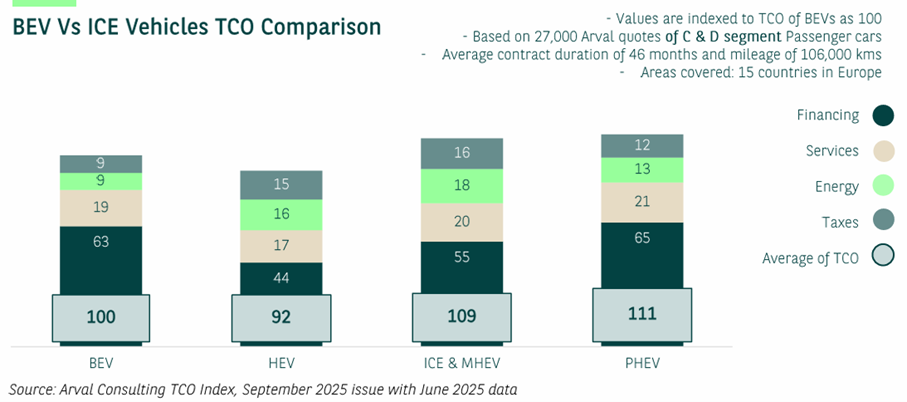
In addition, the energy cost for electric vehicles represents a smaller part of the overall cost (10-15% whereas for combustion vehicles it is around 25-30%).
This study, based on 27 000 Arval quotes of C and D segment passenger cars from 15 countries in Europe, also shows that for BEVs the financing cost represents on average 63% of the TCO but the energy only 9%. For conventional powertrains (ICE, HEV, PHEV), the financing cost is 52% but the energy cost is on average 16% of the Total Cost of Ownership. This showcases well that even if the cost of first purchase is higher for BEVs, the lower energy cost does compensate in part.
Furthermore, battery electric vehicles are often subjected to government incentives which further decreases the financing cost.
If you take for example, a Hyundai Kona 1.6 N Line which runs on petrol and its equivalent in electric (Kona Advance 65kWh) you’ll see that they have the same purchase price. But when adding all the elements that makes the total cost of ownership, which a purchase term of 8 years, you’ll find a difference of 5,200£ in favor of the electric engine.
As a second example, if we look at LCVs, if you compare a diesel Ford Transit Custom (2.0 EcoBlue L1H1 Trend) and an electric one (e-Transit L1H1 Trend 65kWh) you’ll see that for a purchase price close to 6,000£ higher, you’ll actually have a TCO higher by only 151£. The difference in the end is marginal.
Conclusion
The Total Cost of Ownership is an important element to consider when looking at electric vehicles. It varies from one country to another as there are differences in polices, tax and incentives. For used car professionals, it is a great tool to explain to customers the different expenses surrounding the purchase of an EV.